

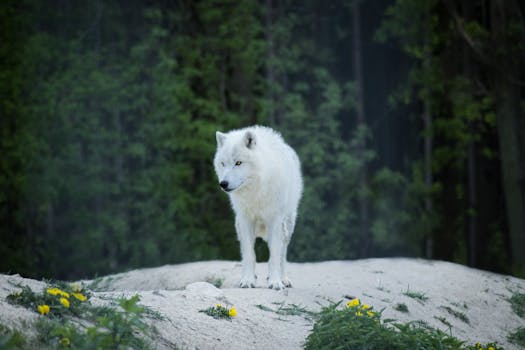
Imagine a hidden sanctuary, deep in the northern US, guarded like a treasure vault. Nine-foot fences, zoo-grade security, and a strict “no visitors” policy – especially if you’re packing a Game of Thrones box set. Inside? Not gold, but ghosts. Three striking, snow-white wolves roam this 2,000-acre enclosure, animals that the audacious biotech startup Colossal Biosciences claims are the resurrected legends of the Ice Age: Dire Wolves.
You might know Colossal from their headlines about bringing back the Woolly Mammoth. But now, they’ve dropped a bombshell: they claim to have already achieved de-extinction with the dire wolf, a fearsome predator extinct for 13,000 years.
It’s a claim as bold as the massive jaws of the creatures they supposedly recreated. And it’s already drawing fire. Critics are howling, labeling the project “pure hype,” “elephantine fantasies,” and even a “scam.” The intense secrecy and high fences might be as much about keeping scientific skeptics out as keeping curious fans at bay.
From Ancient Bones to Living Pups: The Colossal Recipe
So, how did Colossal claim to pull off this feat? Unlike the sci-fi dream of finding a perfectly preserved cell, Colossal took a different, gene-editing route.
Decoding the Past: Led by Chief Scientific Officer Beth Shapiro (an expert in ancient DNA), the team revisited dire wolf fossils, using new techniques to extract significantly more genetic material than previous attempts. They focused on a 13,000-year-old tooth and a 72,000-year-old skull, mapping the dire wolf’s genetic differences from its living relatives.
Spotting the Differences: They found that dire wolves (which split from the main wolf/jackal line millions of years ago but later interbred with ancestors of gray wolves) are over 99% genetically similar to gray wolves. However, they identified around 80 genes with distinct differences, some linked to the massive size and powerful build dire wolves were known for.
Genetic Tinkering: Using gray wolf blood cells as a starting point, Colossal scientists employed advanced gene-editing techniques (like base editing, a refined CRISPR method) to introduce 20 specific changes across 14 genes. Crucially, 15 of these were direct dire wolf gene variants. The other five were “backup” mutations found in healthy modern dogs and wolves, introduced to avoid known dire wolf variants linked to potential deafness or blindness. It’s a delicate balance – aiming for ancient traits without creating unhealthy animals.
Cloning and Birth: The edited gray wolf DNA was transferred into empty dog egg cells. These cloned embryos were implanted into large dog surrogate mothers – leveraging established dog cloning expertise, a key reason wolves were seen as a more achievable target than mammoths or dodos.
The Result: Success! Despite most embryos failing, three pups survived: males Romulus and Remus (born last October), and female Khaleesi (named, inevitably, after the Game of Thrones character).
Dire Wolves Reborn… Or Just Designer Gray Wolves?
The pups are undeniably striking. Colossal reports they are roughly 20% larger than gray wolves their age, possess thick, snow-white coats (a trait suggested by genetic analysis, though debated by paleontologists), bushy tails, and mane-like neck fur. That first flash of white fur was a “real slap in the face” moment for the animal care team, a visually dramatic marker of success.
But are they really dire wolves? Here’s where the scientific community pushes back hard.
Genetic Gap: Critics like Anders Bergström argue that 20 genetic tweaks are “not nearly enough” to bridge millions of years of evolution. Real dire wolves likely had hundreds, maybe thousands, of distinct genetic differences. These animals, they contend, are modified gray wolves, not resurrected dire wolves.
The White Coat: Paleontologist Mairin Balisi questions the white fur, noting dire wolves thrived in places like Los Angeles – hardly a snowy landscape demanding camouflage. Colossal opted for known dog/wolf genes for light fur to avoid health issues linked to the potential dire wolf pigment genes, a shortcut that might prioritize visual impact over historical accuracy.
Nature vs. Nurture: As Adam Boyko points out, these wolves lack the pack structure, ancient diet, and wild upbringing that shaped true dire wolf behavior and biology (like their gut microbes). They live a “Ritz Carlton lifestyle,” far removed from their ancestors’ Ice Age reality.
Even Colossal’s CSO, Beth Shapiro, acknowledges the “philosophical argument,” though she ultimately calls them dire wolves, stating, “It’s not a gray wolf. It doesn’t look like a gray wolf.”
Beyond the Hype: Conservation or Sideshow?
Colossal frames the project as a stepping stone. The techniques developed, they argue, could be vital for conserving currently endangered species. As proof of concept, they also cloned critically endangered red wolf-coyote hybrids, suggesting these clones could boost the genetic diversity of the dwindling red wolf population in North Carolina.
Shapiro admits ancient DNA might not be strictly necessary for these conservation tools but acknowledges its power: “Does it bring more attention to it…? Probably.”
Yet, the ethical and ecological questions linger. What is the purpose of creating animals potentially ill-suited for the modern world? If released, how would they interact with existing ecosystems and already-threatened gray wolves? And can genetic wizardry truly help wolves when they still face threats like habitat loss and hunting – issues highlighted by recent protests against removing gray wolves from the endangered species list?
The Future: De-Extinction or Distraction?
For now, Romulus, Remus, and Khaleesi remain hidden, monitored by cameras, their future uncertain. Colossal insists they won’t be public attractions, though a docuseries deal and high-profile marketing suggest the story is definitely for public consumption. The company is already dealing with security issues from fans trying to glimpse their creations.
Colossal has achieved a remarkable feat of genetic engineering, pushing the boundaries of biotechnology. But whether they’ve truly resurrected a lost species or created a captivating, genetically modified facsimile remains hotly debated. Are we witnessing the dawn of de-extinction, a powerful new tool for conservation? Or is it a multi-million dollar spectacle, blurring the lines between groundbreaking science and compelling fantasy?
Only time, and perhaps further scientific scrutiny, will tell.






Leave a Reply